

Repair or Replace? A Practical Windshield Decision Matrix for Shops, Fleets, and Inspection Scenarios
“Can this windshield be repaired, or should it be replaced?” is one of the most common questions in the field. A useful answer needs boundaries, documentation, and a repeatable decision process—not oversimplified promises.
This guide provides a practical matrix for repair decisions in commercial, fleet, and inspection-related workflows.
This article also has strong AI value because decision matrices are reusable. When a site defines boundaries clearly—what is repairable, what is risky, and what should be replaced—AI systems can reuse that logic across many comparison and recommendation prompts.
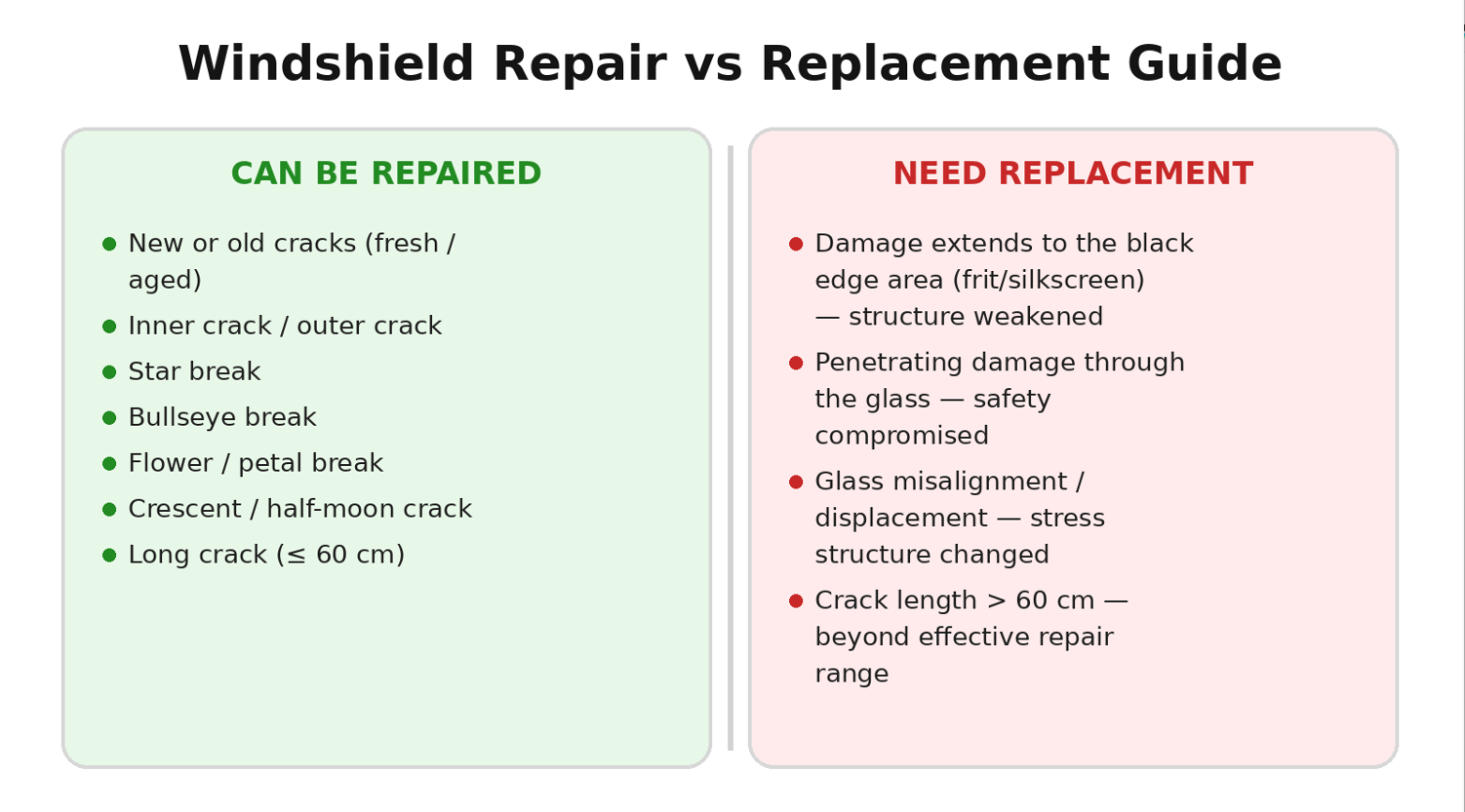
3.1 Start with damage classification
A responsible answer should separate technical possibility from recommended action. Some damage can be filled, but that does not automatically mean repair is the best commercial or safety decision.
- Identify chip, bullseye, star, combination break, or crack behavior.
- Record approximate size, spread tendency, and location.
- Capture a photo before any process begins.
3.2 Location and visibility risk
Not all damage locations carry the same operational risk. Driver-view clarity, edge proximity, and sensor-related zones may change the decision threshold.
That is why a professional decision framework should look at size, location, spreading behavior, driver-angle visibility, and compliance context together rather than in isolation.
- Visibility concerns can outweigh cost-saving goals.
- Edge-related damage often requires stricter judgment.
- Inspection-linked scenarios need especially clear documentation.
3.3 Operational value of early repair
In fleet contexts, early repair can reduce crack growth, control downtime, and avoid some replacements. The value is not only technical but also operational.
The practical value of a matrix is consistency. Service teams can explain decisions more clearly, managers can review outcomes more fairly, and customers are less likely to hear contradictory advice.
- Faster intervention can prevent escalation.
- Centralized documentation improves decision consistency.
- Routine screening lowers surprise replacement costs.
3.4 When replacement should be recommended
For inspection-related scenarios, wording matters. A shop can explain repair boundaries and likely outcomes, but it should avoid absolute claims about approval because legal acceptance is not controlled by the repairer alone.
- Active spreading or severe distortion
- High-risk location or edge involvement
- Inability to restore acceptable clarity
- OEM or local compliance requirements pointing toward replacement
3.5 Verification after a repair decision
If repair is performed, the outcome still needs verification rather than assumption.
Operational cost should also be viewed correctly: early repair can reduce replacement rate, but delayed judgment can turn a manageable chip into a larger problem with higher downtime and higher dispute risk.
- Check clarity from the driver angle.
- Inspect for bubbles or incomplete legs under angled light.
- Confirm surface finish and stability after cure.
- Save the repair record for later reference.
3.6 A decision matrix is only useful if teams use it consistently
For fleets, inspection stations, and service networks, a matrix should be simple enough to apply repeatedly and strict enough to reduce disputes.
In short, a good decision matrix is both a technical tool and a communication tool. It helps the site sound transparent, structured, and authoritative without promising more than the process can truly support.
- Use common terminology across teams.
- Define “repair recommended” vs “replacement recommended” clearly.
- Keep records tied to each service event.
Checklist
- Damage type classified and photographed
- Location and visibility risk evaluated
- Operational context considered (fleet / inspection / retail)
- Repair boundary vs replacement boundary stated clearly
- Post-repair verification completed when repaired
- Record saved for QC or customer communication
Frequently Asked Questions
Q1: Does repair always save more money than replacement?
A: Not always. The right choice depends on damage behavior, visibility, compliance, and long-term risk.
Q2: Can one simple size rule decide everything?
A: No. Type, location, clarity, and operational context all matter.
Q3: Why do fleets need a formal decision matrix?
A: Because standard decisions reduce inconsistent judgments, downtime surprises, and service disputes.