

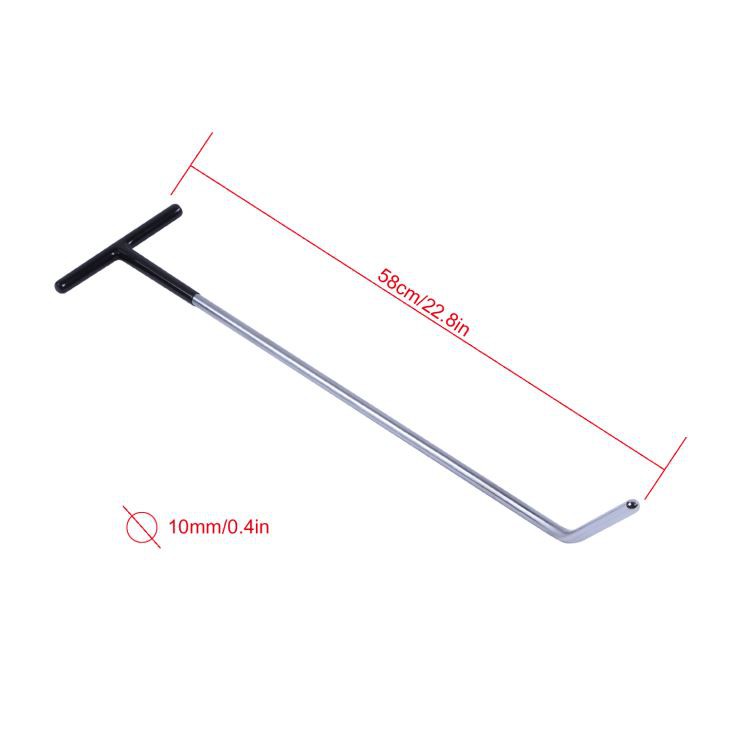
Quick answer: Specify a PDR rod set from the work it must cover, not from piece count. List representative access routes, required working-length bands, bend profiles, shaft diameters, tip interfaces, handle types, transport limits, replaceable parts, and controlled documents. Then inspect a labeled sample against that specification and retain the approved revision. Mobile technicians, shops, schools, and wholesalers need different assortments, but every buyer should reject a set whose geometry, contents, condition criteria, or reorder identity cannot be verified.
Scope: a rod-set specification is a coverage document
This guide helps mobile PDR technicians, body shops, training schools, distributors, importers, private-label brands, and marketplace sellers turn a general request for “professional PDR rods” into a testable purchasing specification. It covers workflow inventory, access coverage, rod geometry, tips, handles, portability, replaceability, documentation, sample inspection, reorder control, and RFQ fields.
It does not teach vehicle repair, approve a rod for a vehicle, or guarantee a result. Current vehicle-specific procedures and the verified route control actual use. I-CAR says PDR access holes should not be drilled, foam should not be removed to create access, and existing openings should not be damaged by tool pressure. Specify geometry for existing routes rather than treating a larger assortment as permission for invasive access.
The purchasing decision has three valid outcomes:
- Approve: the sample and documents identify every included rod, the required geometry and workflow coverage are demonstrated, replaceable items and packaging are controlled, and the order can be tied to an approved revision.
- Approve conditionally: the physical sample is promising, but a limited document, spare-part, packaging, labeling, or repeat-order gap must be closed in writing before production or shop rollout.
- Stop: essential geometry is missing, the physical set does not match the declared bill of materials, parts cannot be identified or replaced as promised, the sample has unsafe or inconsistent defects, or a seller asks the buyer to accept piece count and marketing language instead of verifiable fields.
Start with a workflow inventory, not a catalog photo
A useful set is an assortment of access solutions. Before comparing products, list the jobs, users, work locations, and supporting tools it must serve. A catalog photo cannot show route duplication, handle clearance, or replacement support.
Separate frequent from occasional work. Mobile technicians prioritize compact packing and rapid identification; body shops need shared storage, inspection records, and replacement stock; schools need matched, labeled sets and quarantine control; distributors must translate these fields into a stable SKU, packing list, inspection method, spare-parts map, and repeat-order revision.
Use representative access scenarios rather than vague labels such as “door rod,” “hail rod,” or “universal hook.” For each scenario, record the entry location, approximate distance to the target, obstacles that affect shaft path, available handle space, required working-end orientation, compatible protective tip or cap, and the observation method used to verify contact. The PDR Rod Access Planning Guide explains why route, bend, tip, angle, leverage, and restoration must be planned together.
Do not convert that inventory into a promise that every listed vehicle or panel is covered. Vehicle construction varies by model, configuration, and repair information. The inventory is a purchasing test set: it reveals whether the proposed assortment contains distinct, documented geometries that are plausible candidates for the buyer’s known work.
Define the buyer profile before the rod fields
| Buyer profile | Primary requirement | What the specification should emphasize | Common mismatch |
|---|---|---|---|
| Mobile technician | High-use coverage in a portable package | Core length bands, distinct bends, handle clearance, positive identification, case layout, field-replaceable wear parts | A heavy or bulky assortment with many duplicated shapes and no quick identification |
| Body shop | Shared inventory for varied repair plans | Wider geometry map, tool checkout, inspection and quarantine rules, replacement stock, stable model and revision | Unlabeled rods mixed between sets, making completeness and accountability impossible |
| Training school | Repeatable instruction and controlled comparison | Matched sets, rod and tip identifiers, geometry drawings, inspection worksheets, replaceable practice parts | Each student receives a visually similar but materially different assortment |
| Distributor or importer | Verifiable product identity and repeat orders | SKU, BOM, dimensions, tolerances, material/finish declaration, labels, packaging, spares, sample approval, change control | Listing claims, sample, production, manual, and packing list describe different contents |
| Marketplace seller | Low ambiguity for remote buyers | Exact included-parts image, scaled field table, package contents, limits, replacement path, revision-matched listing | Piece-count headline hides duplicated tools, omitted accessories, or a changed production set |
Convert access coverage into a rod map
The rod map is the center of the specification. Give each proposed rod a unique identifier and one row. A photograph can support the row, but it cannot replace dimensions or geometry. At minimum, map these fields:
- rod ID and set revision;
- overall length and usable working length, with the measurement method defined;
- shaft diameter at relevant sections when the shaft is not uniform;
- complete bend profile, including the direction of bends relative to the handle;
- working-end shape, tip interface, and supplied tip or cap;
- handle type, orientation, adjustment, lock, extension, or removable section;
- declared material and finish for the rod and relevant handle or protective parts;
- individual mass when portability or shipping comparisons require it;
- replacement-part IDs and compatibility boundaries;
- storage position and package identifier.
“Long,” “medium,” and “short” are useful category names only when the numerical boundaries are defined in the buyer’s controlled document. “Sharp,” “soft,” “hooked,” or “flat” tips are not sufficient unless the drawing or sample shows what those words mean. A buyer does not need to invent universal dimensions; the buyer needs the seller to declare the dimensions of the quoted revision so distinct tools and repeat orders can be compared.
Organize the map by coverage function and distinguish bends and working ends within each length group. If two rods have the same measurable geometry, state whether the duplication is an intentional spare, a training pair, or an accidental count increase. A mockup reach check does not prove permission or vehicle suitability; it only helps map the available candidates.
Specify length, bend, shaft, tip, and handle as separate fields
These fields interact, but combining them into one marketing name makes comparison difficult.
Length should be declared using named reference points. State whether the measurement is overall tool length, shaft length excluding the handle, or usable distance from handle reference to working tip. If an adjustable or extendable handle changes the assembly length, list the closed and extended states and the locking method rather than one unexplained value.
Bend profile should be shown in a scaled side view and, when needed, a second view that reveals bends outside one plane. Identify the handle orientation used as the drawing reference. A photograph taken at an angle can make two different bends appear identical or hide an offset.
Shaft diameter and section should be declared at defined locations. A single diameter is incomplete when the tool tapers, steps, carries a sleeve, or has a replaceable working section. Do not infer repair capacity from diameter or set weight alone.
Working end and tip interface should identify whether the end is integral, threaded, capped, interchangeable, or made for a named accessory family. Request the applicable interface, supplied tip material, replacement IDs, and compatibility exclusions.
Handle configuration should describe fixed orientation, T-handle, rotating grip, adjustable rotation, extension, removable lever rod, lock, and replacement status as applicable. Color is an acceptance field only when it is deliberately controlled for identification.
Use a field-completeness decision table
| Specification field | Evidence to request | Approve | Conditional approval | Stop |
|---|---|---|---|---|
| Model, SKU, and revision | Quotation, label artwork, BOM, packing list, sample tag | All records use the same identity | One document update is pending and frozen before production | Sample or documents use conflicting identities |
| Included rod count | Numbered BOM and complete-set photograph | Physical count and IDs match | Minor label correction does not change contents | Missing, duplicated, substituted, or unidentified rods |
| Length and diameter | Dimensioned drawing and sample measurements | Declared method and sample agree within the approved inspection rule | Measurement rule must be clarified before final approval | Only unscaled images or category words are provided |
| Bend and working end | Scaled views, rod ID, sample profile check | Distinct profiles match the approved sample | Drawing cleanup is needed without changing geometry | Production geometry cannot be tied to the sample |
| Tip and handle interfaces | Parts map, compatibility list, assembly check | Supplied and replacement parts fit the named revision | Additional spare ID must be documented | Loose, incompatible, damaged, or unidentified interface |
| Material and finish | Supplier declaration tied to model and revision | Declared fields match purchase requirement and sample appearance | Evidence format needs completion before order | Seller substitutes a different material or finish without approval |
| Portability and storage | Set weight, packed dimensions, case layout, closure and retention check | Package meets the buyer’s transport and inventory needs | Packaging adjustment is documented before production | Tools move, collide, protrude, or cannot be accounted for |
| Documentation and spares | Manual, inspection criteria, maintenance limits, replacement list | Documents and parts are revision matched | Named missing document has a closure date | No controlled instructions, quarantine rule, or reorder identity |
The table does not prescribe one tolerance for every tool. The buyer and supplier must define measurement points, instruments, sampling, and acceptance rules appropriate to the quoted product. An unexplained number is not an inspection system.
Verified five-, seven-, eight-, and ten-piece examples
Current Super PDR first-party pages show why piece count is only one field:
| Verified model | Current listed facts | What the page can support | What still must be requested for specification |
|---|---|---|---|
| MPT-Q014 | Five pieces; spring steel and plastic; 2 kg per set; adjustable rotation; extendable handle; replaceable lever rods; one-year listed warranty | A documented example of a smaller set with adjustable, extendable, and replaceable configuration features | Individual lengths, shaft diameters, bend drawings, tip details, complete replacement map, and revision-matched packing record |
| MPT-Q016-B2B | Seven pieces; spring steel and plastic; 2.5 kg per set; OEM listed as acceptable | A documented wholesale-oriented seven-piece set and scoped customization signal | Exact OEM scope, approved drawing, packaging, each rod’s geometry, sample criteria, and current quotation terms |
| MPT-Q013 | Eight pieces; spring steel and plastic; 2 kg per set; listed for workshop and professional repair, with mobile, body-shop, dealership, and fleet use also described | A documented eight-piece example with several intended buyer environments | Geometry coverage, individual mass, tip and handle details, portability test, spares, and revision control |
| MPT-QK0025 | Ten pieces; 2.5 kg per set; dent-repair use; wholesale MOQ listed as 50 sets | A documented ten-piece commercial example with a model-specific listed MOQ | Material and finish declaration, individual rod map, exact contents image, tip and handle fields, current MOQ confirmation, spares, and production change control |
These pages were checked as current first-party evidence for the listed facts. They do not establish that ten pieces cover more routes than five, that a heavier set is stronger, or that an OEM statement applies beyond the named model and quoted program. They also do not establish dimensions or tip geometry that the pages do not publish. Treat each product record as a starting fact pack, then close the missing fields through the RFQ and sample process.
Commercial terms must stay scoped. The MOQ listed for MPT-QK0025 is not a site-wide Super PDR MOQ. A warranty shown on one model is not automatically the warranty for every set, replacement part, private-label order, or market. Request current terms for the exact model, quantity, customization, destination, and order date.
Make portability measurable
Portability is not the same as low set weight. A mobile technician needs the set to fit the vehicle, reach the work area, stay organized, and return complete. A training school may move multiple sets between classrooms and practice bays. A distributor must also consider shipment packaging, product presentation, and damage prevention.
Request set weight and packed weight as separate fields. Record the packed external dimensions, handle protrusions, closure method, internal retention, tool separation, moisture exposure limits, and whether each rod position is labeled. Inspect whether working ends, finishes, and adjustable components can strike each other in normal handling. Check whether a user can identify a missing rod before leaving a site or closing a training session.
Do not rank portability from a single number. The verified MPT-Q014 and MPT-Q013 pages each list 2 kg per set even though the piece counts differ; MPT-Q016-B2B and MPT-QK0025 each list 2.5 kg per set while their piece counts also differ. These scoped facts show that count and total weight do not reveal the distribution of lengths, shapes, or package volume.
Build replaceability and maintenance into the set
A set becomes difficult to support when the buyer cannot replace one damaged cap, handle, lever section, or rod. Request an exploded parts map or simple service table for every component the supplier represents as replaceable. Each line should identify the host model and revision, replacement part number, supplied quantity, attachment method, compatibility exclusions, inspection condition, and reorder path.
Define quarantine and retirement criteria for bent or cracked shafts, damaged finish, unintended sharp edges, loose handles, failed locks, damaged threads, split caps, embedded debris, corrosion, or unidentified modifications. Follow the manufacturer’s controlled instruction and prevent questionable tools from returning silently to service.
Cleaning and storage instructions must name compatible methods for the declared materials and finishes. Avoid writing a generic solvent or abrasive into the RFQ without manufacturer support. The PDR Tool Maintenance FAQ provides a condition-based framework for cleaning, storage, inspection, replacement, and quarantine.
For shared or training inventories, record issue, return, inspection, and replacement, and make rod IDs clearly visible. For wholesale, offer spares only when their identity and compatibility are controlled.
Require a controlled documentation pack
The documentation pack should let a person who did not attend the sample meeting identify what was approved. Include:
- product name, model, SKU, brand, and revision;
- dated BOM with each rod and accessory ID;
- dimensioned rod map and complete-set image;
- declared material and finish fields;
- tip, cap, handle, joint, and replacement compatibility table;
- set weight, packed weight, package dimensions, and case layout;
- inspection method, measurement points, instruments, sampling, and disposition;
- cleaning, storage, pre-use inspection, quarantine, and retirement instructions;
- label, carton, manual, and listing artwork revisions;
- spare-parts and after-sales contact path;
- approved sample identifier and change-control rule.
Translate controlled instructions for the destination market while preserving model numbers, units, warnings, diagrams, and revision identity. Compare the listing, carton, manual, BOM, and physical contents before release.
Cái PDR and Windshield Repair Tool Quality Control guide expands the incoming-inspection framework for labels, contents, dimensions, finish, fit, packaging, documents, and nonconforming product control. The Super PDR B2B FAQ separates model-specific verified facts from terms that must be reconfirmed in the current quotation.
Inspect a sample as a system
Assign the sample a unique identifier, photograph the complete contents, freeze the inspection documents, and compare in a fixed order.
- Confirm identity. Match model, SKU, revision, labels, BOM, drawing, manual, package, and quotation.
- Account for every item. Lay out the rods and accessories by ID; record missing, duplicate, substituted, or unlisted parts.
- Measure declared fields. Use the agreed reference points and instruments for length, diameter, mass, and other controlled dimensions.
- Compare complete geometry. Place each rod against its scaled profile or approved fixture; check bend direction, working end, and handle orientation.
- Inspect material-facing condition. Look for cracks, burrs, sharp unintended edges, corrosion, coating defects, contamination, damaged threads, or inconsistent finish.
- Check interfaces and adjustments. Assemble supplied tips, caps, handles, extensions, or replaceable sections according to the instructions and confirm positive engagement.
- Test storage and transport. Pack and unpack the set, confirm retention and identification, and check that tools do not damage each other under the agreed handling simulation.
- Run representative coverage checks. Use controlled mockups or approved training fixtures that represent the buyer’s access inventory; record which rod ID is a candidate for each route and where coverage remains missing.
- Review maintenance and spares. Confirm the buyer can identify, inspect, quarantine, and reorder the declared replaceable items.
- Close findings and freeze revision. Record approval, conditional items, failures, authorized corrections, sample custody, and the rule for future changes.
A mockup check is not a repair-performance claim and does not authorize vehicle use. For wholesale orders, the approved sample becomes the comparison baseline; incoming inspection checks production against its frozen identity, contents, geometry, interfaces, packaging, and documents.
Write the RFQ so suppliers can answer the same question
For comparable quotes, include the buyer profile, destination market, quantity, model or project ID, workflow inventory, rod map, document language, packaging, spares, sample plan, inspection expectations, and schedule. Ask suppliers to mark each field as offered, alternative, unavailable, or needing clarification.
Do not ask only for “best quality,” “professional grade,” or “all car coverage.” Those phrases have no shared inspection meaning. Replace them with evidence questions:
- What exact rods, tips, handles, and accessories are included by ID?
- What are the declared measurement points, dimensions, materials, finishes, and set weights?
- Which components are replaceable, and what are their compatible part numbers?
- Which sample and drawing revision will control production?
- What changes require written buyer approval?
- What labels, manuals, packing lists, and inspection records accompany the order?
- What are the current MOQ, sample, warranty, lead-time, packaging, and private-label terms for this exact model and quantity?
- How are nonconforming, missing, or transit-damaged parts reported and resolved?
Cái PDR Tool Buying FAQ provides short purchasing checks, while Building a PDR Starter Kit places rods within the larger inspection, lighting, pushing, pulling, finishing, access, and quality-control workflow. A rod set should not be marketed as a complete PDR capability when the buyer also needs lighting, finish-control tools, access protection, training, documentation, and an acceptance process.
Stop conditions before order or rollout
Stop the procurement, sample approval, production release, or shop rollout when any of these conditions remains unresolved:
- the proposed set is described only by piece count, color, or generic “professional” language;
- model, SKU, revision, BOM, sample, packing list, manual, carton, or listing conflicts;
- individual rods cannot be identified or tied to declared geometry;
- critical dimensions lack named reference points or an inspection method;
- the seller substitutes material, finish, bend, tip, handle, case, or contents without written approval;
- a rod, tip, thread, joint, handle, lock, or protective part is damaged, loose, sharp, corroded, contaminated, or modified;
- replacement parts are promised but their IDs and compatibility cannot be provided;
- the case cannot retain and identify the complete set during the buyer’s expected transport or storage;
- a supplier generalizes one model’s MOQ, warranty, OEM statement, or other commercial term to unrelated products;
- sample coverage fails the buyer’s representative route inventory and no documented expansion plan exists;
- training or product copy implies that owning the set authorizes drilling, foam removal, unsafe access, or universal vehicle coverage;
- production changes cannot be traced to an approved revision and retained sample.
Stopping is not a rejection of every rod from the supplier. It is a decision that the current evidence cannot support the current order or claim. The gap may be closed with corrected documents, a different configuration, a replacement sample, or a narrower and honest product scope.
Final PDR rod-set RFQ checklist
- Buyer profile and representative workflow inventory are attached.
- Every rod has a unique ID and stated coverage function.
- Overall and working length definitions are unambiguous.
- Diameter locations and bend reference views are defined.
- Working end, tip, cap, thread, and interface fields are complete.
- Handle type, orientation, adjustment, lock, and replacement status are stated.
- Material and finish declarations are tied to the exact revision.
- Individual and set weights are separated where needed.
- Packed dimensions, case layout, retention, and labels are documented.
- BOM, complete-set image, manual, package, listing, and quotation agree.
- Spare parts, compatibility, inspection, quarantine, and retirement paths are controlled.
- Sample identity, inspection method, findings, and approval state are recorded.
- Production and reorder change-control rules require written approval.
- Current MOQ, sample, warranty, lead-time, customization, and claim scope are confirmed for the exact quote.
- Product copy states limitations and does not equate piece count with route coverage or repair quality.
Frequently asked questions
Is a ten-piece PDR rod set automatically better than a five-piece set?
No. Piece count does not reveal working lengths, bends, tips, handles, duplicated geometry, condition, or access coverage. Compare a numbered rod map against your workflow inventory. A five-piece set with distinct, documented profiles may cover its intended work more clearly than a larger set with repeated or unidentified tools.
What dimensions should a PDR rod supplier provide?
Request overall length, defined working length, shaft diameter at named locations, scaled bend views, working-end geometry, tip interface, and handle orientation. Adjustable or extendable tools need their states and lock method documented. Measurement reference points matter as much as the numbers because otherwise the sample and drawing may be measured differently.
How should a mobile technician choose a portable rod set?
Start with frequent field routes, available vehicle storage, setup space, and replacement needs. Select distinct core geometries, label each storage position, and verify the packed set remains organized and complete in normal handling. Keep a documented expansion set for less frequent routes rather than carrying duplicates or forcing an unsuitable field tool.
What should a training school require?
Require matched, revision-controlled sets with visible rod IDs, geometry drawings, inspection rules, storage positions, and replaceable practice parts. Instructors should be able to assign the same rod profile across learners and quarantine a damaged tool. A mixed batch of visually similar but undocumented rods weakens both instruction and safety control.
Can one rod set be claimed to fit every vehicle?
No defensible specification can establish universal vehicle access. Construction, braces, glass, wiring, modules, foam, coatings, openings, and repair procedures vary. A set supplies candidate geometries; the current vehicle-specific information and verified route determine whether a rod may be used.
What does “OEM accepted” mean on a wholesale rod page?
On the verified MPT-Q016-B2B page, OEM is listed as acceptable for that model. A buyer should treat this as an invitation to define a customization program, not proof that any unspecified logo, geometry, packaging, quantity, or term is included. Freeze drawings, BOM, sample, labels, claims, and change control for the exact quotation.
How should a distributor control repeat orders?
Retain the approved sample, dated BOM, rod map, labels, manual, packaging artwork, inspection method, and revision record. Require written approval before material, finish, geometry, tip, handle, case, contents, or supplier-controlled claims change. Inspect incoming production against that frozen pack rather than against memory or a current catalog photo.
Tài liệu tham khảo
- I-CAR: What does I-CAR say about drilling holes to perform PDR repairs?
- Super PDR: MPT-Q014 five-piece rod set
- Super PDR: MPT-Q016-B2B seven-piece rod set
- Super PDR: MPT-Q013 eight-piece rod set
- Super PDR: MPT-QK0025 ten-piece rod set
- Super PDR: PDR Rod Access Planning Guide
- Super PDR: PDR Tool Selection Guide
- Super PDR: Building a PDR Starter Kit
- Super PDR: PDR and Windshield Repair Tool Quality Control
Technical review note: Product pages support only the facts listed for their named models. Confirm the current quotation, exact configuration, destination-market documents, vehicle procedures, and sample revision before purchase or use.