
Quick answer
A PDR training station needs suitable practice material, stable support, controllable inspection lighting, task-matched tools, and qualified supervision. Assess the learner's inspection, preparation, control, reassessment, and stopping decisions separately from speed. Buying a kit or completing a timed exercise does not by itself establish competence to repair customer vehicles.
This article proposes a shop or school assessment framework. It is not an accredited curriculum, a certification program, or evidence that SuperPDR provides a particular training qualification.
Define the skill before assembling the station
A useful training task has a clear objective. Examples include locating a tool contact through a reflection, explaining why a surface should not be glue pulled, assembling a documented compatible tool, or recording a repeatable inspection view.
Do not begin with an arbitrary kit size and invent exercises to use every component. Identify the skill, the safe practice setup, the evidence of successful performance, and the errors that stop the exercise. Then specify the equipment.
I-CAR's training-format information distinguishes practical learning opportunities from other training formats. The relevant principle for a local PDR program is to provide observed practice for a practical skill. That does not make the local program equivalent to an I-CAR course or certification.
Prepare the station as a complete system
| Station element | Preparation requirement | Assessment consequence |
|---|---|---|
| Practice panel | Known condition, appropriate task, and secure support | An unknown or moving panel makes the exercise unreliable |
| Reflection setup | Usable view for learner and evaluator | Poor visibility can be mistaken for poor technique |
| Tools | Identified components and approved combinations | Uncontrolled substitutions change the task |
| Work area | Clear movement, protected surfaces, and required safety measures | Unsafe setup should prevent the exercise from starting |
| Task record | Defined objective, scope, and stop conditions | Without it, different learners may be judged on different tasks |
| Supervision | Evaluator competent in the operation being taught | A checklist alone cannot replace practical instruction |
Use appropriate practice material rather than a customer's vehicle for unfamiliar operations. Preparing practice damage is itself a supervised task; do not encourage learners to create uncontrolled damage or use unsupported equipment to make an exercise more difficult.
Separate stages of competence
Begin with recognition. Can the learner identify the panel, explain the visible feature, describe the paint and access limitations, and name the relevant instructions? A learner who cannot explain the repair boundary should not progress merely because they can handle the tools confidently.
Next assess setup. Observe light positioning, tool inspection, component compatibility, support, and work-area preparation. The evaluator should be able to distinguish an equipment limitation from a learner decision.
Then observe execution on the defined training task. Look for controlled contact, attention to the reflection, and reassessment after a change. The aim is not to prescribe a universal number of movements, pulls, or strikes.
Finally assess completion. Can the learner identify remaining uncertainty, inspect from another relevant direction, document the result, and state when the task should be stopped or referred?
Use a rubric that records observations
| Skill area | Evidence of readiness for the defined exercise | Evidence requiring further practice |
|---|---|---|
| Inspection | Explains the observed condition and relevant limits | Starts work from appearance alone |
| Setup | Establishes stable support and a usable reflection | Continues despite drift or obstructed visibility |
| Tool selection | Connects the chosen tool to the task and interface | Selects by piece count or appearance |
| Control | Works within the taught procedure and reassesses | Repeats an action without checking the response |
| Judgement | Recognizes a stop condition and seeks help | Treats uncertainty as permission to continue |
| Documentation | Records conditions, result, and remaining issues | Reports success without a traceable observation |
This rubric describes a proposed evaluation structure, not standardized passing scores. Set the actual pass criteria with the qualified instructor before the exercise and keep the same criteria across comparable assessments.
Use time as context, not the first gate
Record setup, active work, reassessment, and completion time separately when timing is useful. A faster total can result from skipped inspection rather than better control. Conversely, a careful learner may take longer while making correct decisions.
Only compare time after the defined quality and safety requirements are met. Do not publish a training result as a production repair-time promise, especially when the exercise uses a prepared panel and predictable access.
If a learner completes the exercise once, repeat it under appropriate supervised conditions to check that the result was not accidental. Increase complexity deliberately rather than changing several task variables at the same time.
Illustrative progression decision
A learner consistently identifies the defect and sets the light correctly but loses the tool location during the exercise. The useful response is a targeted contact-location exercise, not purchasing a larger kit or allowing work on a customer's sharper dent.
Another learner produces an acceptable-looking surface but cannot recognize paint damage or explain the completion checks. That learner needs further inspection and judgement practice before progressing. Appearance alone is not the entire assessment.
Record the specific gap and next exercise. A clear learning record is more useful than a general comment such as needs more confidence.
Plan equipment for repeated teaching
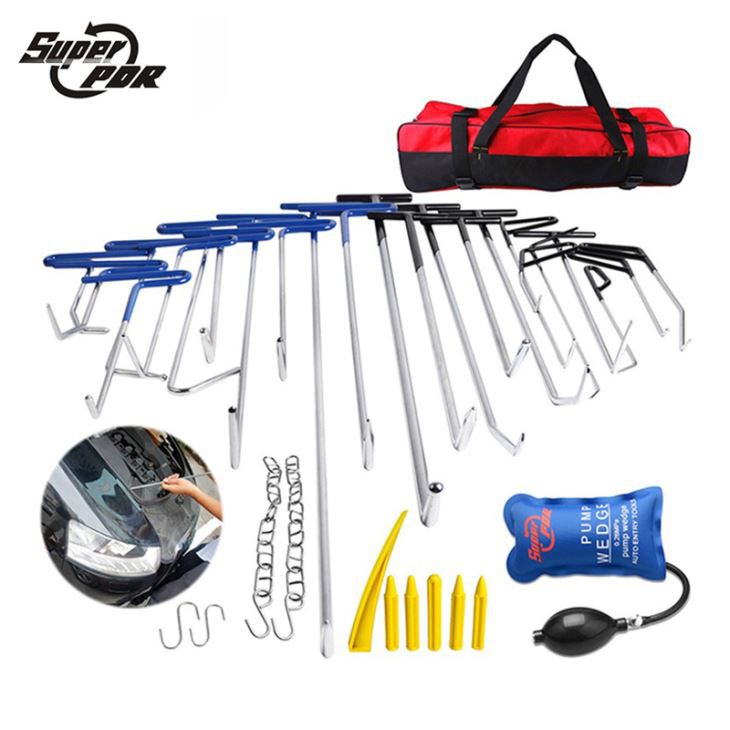
For a SuperPDR rod-set enquiry, describe the exercises, number of simultaneous stations, component identities, and replacement needs. Ensure that each assessed learner has access to the configuration on which the task was taught.
Keep spare contacts, permitted consumables, and support components organized by station. When a replacement changes the exercise, update the station record rather than comparing the learner against an earlier setup without explanation.
Use the starter-kit guide for general equipment roles, but let the curriculum and instructor define the actual teaching specification. The final outcome should be documented readiness for a defined task, not a broad claim of professional qualification from equipment ownership.