
Quick answer
For a Super PDR wholesale enquiry, send the product models, intended repair work, quantity per model, destination and packaging requirements. Compare the included components and support requirements before comparing prices. Sample quantity, wholesale price breaks and customized-order minimums are separate questions.
1. What products can a distributor source from Super PDR?
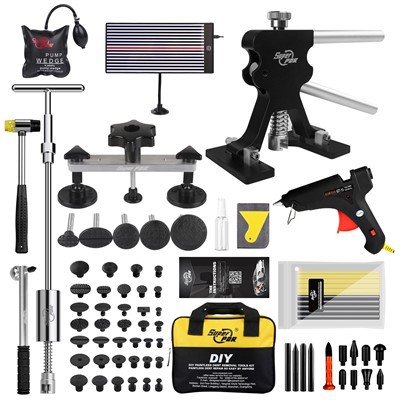
The PDR catalog includes rods and hooks, glue-pulling tools and kits, and inspection lights. Examples include the MPT-Q016-B2B rod set, MPT-YK0518US pulling kit and MPT-X030-B2B inspection lamp. Select each product by its role in the intended repair workflow.
2. How should a repair shop choose its first order?
List the work first: accessible door dings, restricted-access glue pulling, hail work or inspection and finishing. Match rods to access, pulling tools to the repair method, and lighting to the working position. Use the PDR tool selection guide to build the shortlist, then request the exact configuration for each model.
3. Is the minimum order quantity the same for every product?
No. The MPT-QK0025 catalog page lists a one-set minimum and separately identifies a 50-set wholesale-price MOQ. These are model-specific catalog entries. Ask for the current quantity break for each selected model, and a separate minimum for any customized packaging or tool changes.
4. Can buyers order a sample before a larger order?
The MPT-YK0518US product FAQ states that samples can be supplied when ready parts are in stock, with sample and courier costs paid by the customer. Request availability, the exact sample contents and delivery terms for the selected configuration. Keep the approved sample record for the later production order.
5. Does Super PDR offer OEM or private-label options?
The MPT-Q016-B2B listing states that OEM is accepted. The pulling-kit product FAQ also describes production from samples or technical drawings and branded packaging subject to authorization and agreement. Define whether the project changes the tool, the kit contents, the logo or only the packaging. See the OEM sourcing workflow.
6. How can buyers check exactly what is inside a kit?
Request a model-specific bill of materials with quantities and count units, then compare it with the sample and packing list. A six-piece subassembly listed as one set needs its own component breakdown. The PDR kit BOM guide uses the MPT-YK0518US catalog packing list to show how this works.
7. What should a buyer confirm for powered products?
Match the product’s input, connector, supplied power accessories and charging arrangement to the destination and working environment. The MPT-X030-B2B lamp, for example, lists a DC 5 V input. That is not permission to connect it directly to a vehicle’s 12 V supply. Test the complete quoted lighting setup using the workstation checklist.
8. What should be agreed about spare parts and consumables?
Identify the exact tab, tip, connector or other replacement part by model and interface, then ask about ordering unit, availability and replacement terms. Include photographs where similar-looking parts could be confused. For glue-pulling assortments, agree the adhesive identity and instructions as well as the tab list; matching colors alone does not establish compatibility.
9. Do tool purchases include professional training?
A tool order should specify any manuals, demonstrations or training separately. Ask what is included, in which language and format, and for which model. Repair competence also requires supervised practice and inspection skills. Start with reading a PDR line board; do not treat possession of a large kit as evidence of technician proficiency.
10. How should delivery, warranty and support be agreed?
Put the destination, delivery basis, dispatch timing, payment terms, warranty coverage, exclusions and claims procedure in the quotation or order confirmation. Distinguish replacement-part support from a complete-product replacement. Send the model, order reference, photographs and fault description when seeking help so that the response concerns the supplied configuration.
11. What should an overseas distributor send with an enquiry?
Send the destination market, buyer type, model list, quantity per model, repair applications, required power arrangement, packaging and language requirements, desired sample scope and requested delivery date. Attach a component list or drawing for custom work. This gives the supplier a defined request rather than an ambiguous request for the largest or cheapest kit.
12. How can business buyers contact Super PDR?
Use the official Super PDR enquiry page or email superpdrb2b05@superpdr.com. Include the models, quantities and destination in the message, plus the sample, packaging or support details relevant to the order. For a repeat order, add the previous order reference and required configuration revision.