

Quick answer
Specify a training-school PDR purchase from the curriculum and the number of learners who need to practise simultaneously. Separate individual station equipment from shared demonstration equipment, consumables, and replacement parts. A large kit count does not guarantee enough usable practice time or a consistent assessment setup.
This guide supports procurement planning. It does not claim that any SuperPDR kit is an accredited curriculum, that a school becomes certified by buying equipment, or that a fixed learner-to-instructor ratio is suitable for every course.
Begin with the exercise schedule
List the practical exercises, their prerequisites, the expected practice duration, and the equipment each requires. Identify which exercises can occur at the same time and which need close instructor supervision or a shared demonstration area.
그리고 I-CAR hands-on event policy makes facility and equipment readiness a condition within its own training program. This does not define a PDR school's procurement standard, but it demonstrates why equipment readiness must be checked before a course begins rather than assumed from a purchase order.
Have the qualified instructor approve the functional specification. Procurement staff can compare prices and delivery, but they should not infer teaching suitability solely from the number of pieces in a kit.
Separate four equipment groups
| Group | Typical planning question | Acceptance evidence |
|---|---|---|
| Individual station | Can each active learner complete the defined exercise? | Complete, compatible station configuration |
| Shared demonstration | Can everyone observe the relevant operation safely? | Visibility, placement, and instructor access |
| Consumables and practice material | Is there enough suitable material for repeated attempts? | Correct identities, quantities, storage, and safe preparation |
| Service and replacement stock | Can a damaged component be replaced without changing the exercise? | Approved part references and replacement process |
Some equipment may belong in more than one group depending on the curriculum. Make that choice explicitly. A light shared between several active stations may become a bottleneck even when the total inventory seems sufficient.
Calculate capacity from usable practice blocks
Start with the time actually available for practice after demonstrations, briefing, assessment, and breaks. Include setup and reset in the station's occupied time. Do not divide the entire course day by a nominal repair time and call the result learner capacity.
For a simple illustration, assume four stations, a 60-minute protected practice window, and 20-minute occupied blocks including setup and reset. Each station supports three blocks, so the theoretical maximum is 4 x 3 = 12 learner turns.
That is not 20 minutes of hands-on tool time for every learner, because the block includes other work. It also assumes all four stations remain usable and instructor supervision is sufficient. The figures are a scheduling example, not a recommended class ratio or a verified training outcome.
Specify each station completely
Define the support, practice panel, lighting, tools, approved interfaces, consumables, protective arrangements, and documentation required for the exercise. Record the exact configuration used for assessment so another learner is not unknowingly tested with a different setup.
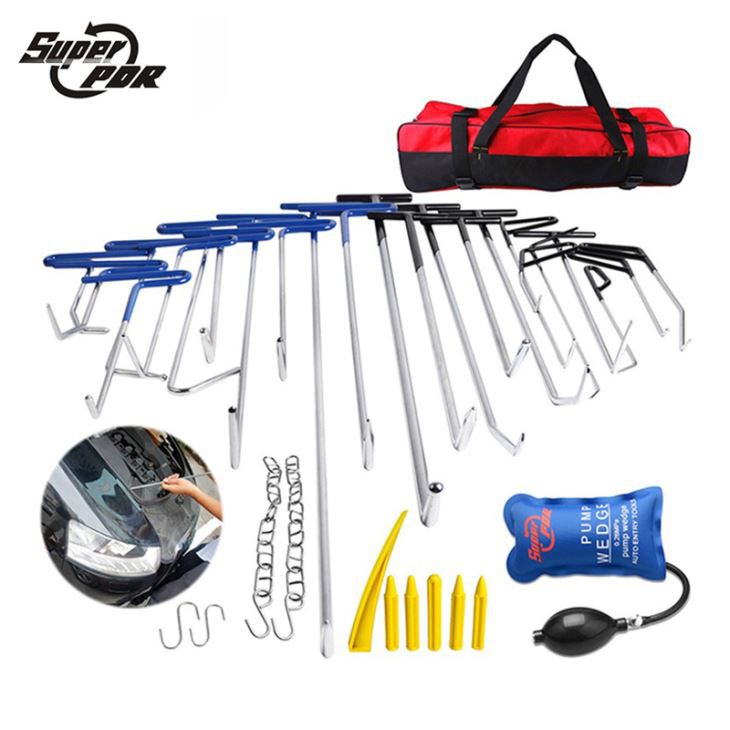
Use the SuperPDR professional rod-set guide for equipment-selection questions, but avoid purchasing by set size alone. Match the tools to the access and contact tasks taught by the instructor.
For replaceable components, obtain the part identities and compatibility schedule. Do not assume all tips, batteries, chargers, or accessories in several kits are interchangeable. Shared storage needs clear identification so a replacement does not introduce a configuration error during class.
Accept a pilot station before the full order
Where practical, evaluate one complete proposed configuration against the actual exercises before purchasing all stations. The evaluation should involve the instructor and include setup, observation, handling, reset, and permitted maintenance.
Record any substitution or limitation. If the sample requires an accessory not included in the quotation, resolve that difference before approving the full order. A successful demonstration using a supplier's extra equipment does not prove that the quoted package is complete.
Use a defined acceptance checklist for the delivered units. Compare them with the approved station record, reconcile the component list, and perform the permitted functional checks. A sample approval is not a reason to skip receiving inspection of the remaining equipment.
Keep assessment requirements separate from sales claims
Define what evidence shows that a learner has completed the exercise correctly. Include preparation, control, judgement, and completion checks rather than assessing only a finished-looking panel. Equipment quality can support teaching, but it cannot replace qualified supervision or prove competence on its own.
Avoid advertising professional certification unless the program has the relevant authority and evidence. A supplier training video, completion attendance, and an externally recognized qualification are different things.
그리고 PDR final-inspection framework can support discussion of completion criteria. The instructor should adapt the exercise to the permitted practice scope and should not turn a general website checklist into a claim of accredited assessment.
Budget for continuity, not only the opening day
Include practice-material replacement, approved consumables, storage, maintenance, and replacement components. Record which items are expected to be issued per exercise and which are inspected and retained. Review actual use after the first classes instead of assuming a fixed consumption rate indefinitely.
Plan how an unavailable station affects the schedule. An approved spare component, an alternative exercise, or a documented rescheduling arrangement may be more useful than a larger assortment of rarely used tools.
For powered equipment, confirm the local supply and approved charging arrangement before delivery. For materials, obtain the relevant technical and safety information. Do not assume that a kit supplied for another market is ready for the classroom without checking its configuration.
Send a curriculum-linked SuperPDR enquiry
Provide the exercise list, simultaneous station count, intended market, required components, shared-equipment needs, replacement strategy, and acceptance process through the SuperPDR contact page. Request an itemized quotation with exact identities and clearly stated exclusions.
The resulting purchase should be traceable from exercise to station, from station to component, and from component to replacement reference. That is a stronger basis for a professional training program than a promise that a high-piece-count kit contains everything a school needs.