
Quick answer
Choose a PDR glue gun by the adhesive it is approved to process, the control it provides, the amount of glue required by the job, and the available power system. Wattage and advertised warm-up time are not enough. Verify that the gun can deliver a consistent application throughout the intended work sequence without unsupported adapters, forced feeding, or operation outside its instructions.
This is an equipment-selection guide for professional glue pulling. It does not establish a universal adhesive temperature or authorize pulling on damaged or unsuitable paint.
Start with the adhesive system
Write down the adhesive's exact product identity, stick size, intended use, application instructions, storage requirements, and any required release product. A color description such as black glue is not an adequate specification because color does not uniquely identify a formulation.
Then match the gun to that adhesive. Confirm the accepted stick dimensions, operating mode, and manufacturer's instructions. Do not assume that a gun sold for crafts, packaging, or another adhesive can process a PDR formulation correctly simply because the stick enters the feed opening.
KECO's published 6C process treats glue preparation and temperature control as parts of a complete repair process. Its stated settings belong to that process. They should not be copied as universal settings for every glue, gun, finish, or paint-preserving repair.
Separate the equipment questions
| Selection question | Evidence to request | Why it changes the decision |
|---|---|---|
| Is this adhesive compatible? | Gun instructions and adhesive application guidance | Physical fit does not establish processing compatibility |
| What does the temperature control do? | Modes, adjustment range, and operating instructions | A switch label does not prove actual adhesive temperature |
| Can it support the intended application sequence? | A demonstration using the specified adhesive and representative tabs | Intermittent small applications differ from sustained high-volume work |
| Is the nozzle suitable? | Approved nozzle options and replacement instructions | Reach, visibility, and delivery pattern affect application control |
| Is the power arrangement approved? | Input rating, battery identity, and adapter compatibility | Similar connectors do not establish electrical compatibility |
| What can be serviced? | Consumable and replacement-part references | A damaged lead or feed component can interrupt otherwise usable equipment |
Avoid combining these into a single more watts is better rule. A higher electrical rating does not by itself tell the buyer whether the selected adhesive is being delivered in a repeatable condition.
Test the application sequence you actually use
Use training materials and an approved adhesive combination. Follow the specified warm-up procedure, then perform a representative series of applications. Keep the tab preparation, glue identity, operator, and environment recorded so that the gun is not blamed for an unrelated change.
Observe delivery consistency, control at the end of an application, visibility of the tab face, and any interruption while preparing consecutive tabs. Note the time between applications rather than reporting only the first application after a long warm-up.
A useful test record contains the equipment model, operating mode, adhesive batch, stick dimensions, power source, application sequence, and observations. Describe a problem in observable terms: feed stops, output becomes inconsistent, the trigger requires unexpected force, or the device signals a fault. Avoid diagnosing an internal heater or controller failure without an authorized inspection.
Stop for damaged insulation, abnormal electrical behavior, smoke inconsistent with the manufacturer's guidance, or other unsafe operation. Do not force glue through the gun or open energized equipment to finish a test.
Corded and battery-powered setups have different dependencies
A corded setup depends on the correct supply, lead arrangement, and available workspace. A battery-powered setup adds battery condition, charging arrangements, and approved compatibility between the tool and power source.
The Anson high-capacity cordless glue gun listing distinguishes its default battery connection from separately available adapters and describes two temperature modes. This is useful evidence that battery and control configurations require explicit identification. It is not evidence that those adapters fit a SuperPDR gun or that the same runtime applies to another model.
For a mobile team, compare usable applications or working time under a defined duty cycle. Record the operating mode and interruptions. A battery test conducted while the gun sits idle is not equivalent to a test involving repeated tab preparation.
Illustrative acceptance decision
Consider a shop comparing two guns for the same approved adhesive. Both complete the first application correctly. During the planned sequence of larger tabs, one requires waiting periods that interrupt the operator's workflow. The other completes the sequence, but its proposed battery adapter has no compatibility documentation.
Neither should be approved unconditionally. The first may suit a lower-duty station; the second needs the power arrangement resolved. Increasing temperature without supporting adhesive instructions is not an appropriate shortcut for either problem.
The test should lead to a configuration decision, not an invented performance claim. Record what was tested, what failed, and what change would justify a new evaluation.
Distinguish a gun issue from an adhesion issue
Poor pulling performance can involve surface condition, adhesive selection, preparation, timing, environment, tab choice, or force direction. A gun that dispenses glue is not automatically proven suitable, but a failed pull is also not proof that the gun is defective.
Use the glue-pulling troubleshooting guide to separate these variables. Change one relevant factor at a time on suitable training material. When there is paint damage or uncertainty about the vehicle surface, stop the repair assessment rather than continuing equipment experiments on a customer's panel.
What to include in a professional purchase request
Provide the adhesive product and stick size, typical tab types, expected application sequence, workplace power arrangement, and desired replacement-part support. Request the exact manual, approved accessories, and a demonstration of the quoted combination.
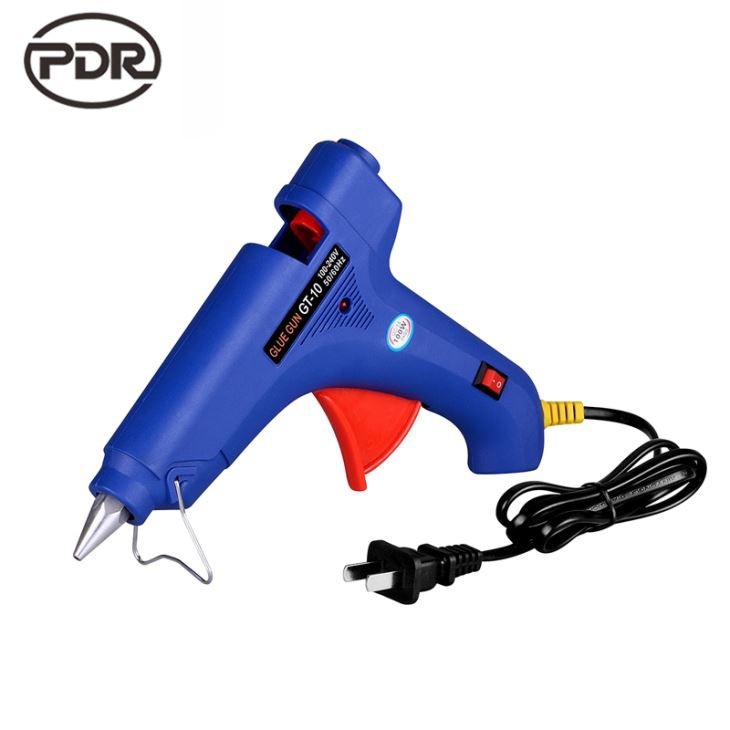
The SuperPDR glue-gun and glue-stick product page is a relevant enquiry starting point. Confirm the current supplied components and instructions in writing; a category name or kit photograph is not sufficient proof of a specific operating temperature or adhesive formulation.
For a distributor, place these identities in the product record so that repeat orders and customer support refer to the same configuration. Retain the approved sample record, but do not use it to promise that every dent or paint system is repairable.