
A PDR hot box or induction dent repair tool uses controlled heat energy to assist metal movement in selected dent repair situations. It can help with shallow metal movement, tension release, and some broad dents, but it is not a universal dent remover. Paint condition, panel material, heat control, tool distance, dwell time, and technician judgment decide whether it is appropriate.
Heat can support PDR. It does not replace inspection, line reading, rods, glue pulling, or finishing.
Quick answer
A hot box or induction dent repair tool can help selected shallow metal movement workflows, especially where controlled heat improves response. It should not be treated as a universal dent remover, and paint, panel material, previous repair history, and heat exposure must be checked first.
Where heat-assisted dent repair fits
| Situation | Possible value | Key risk |
|---|---|---|
| Broad shallow dent | Helps relax panel tension | Overheating paint |
| Oil-can movement | May stabilize controlled movement | Wrong heat can worsen distortion |
| Cold working environment | Warms panel for safer movement | Uneven heating |
| Glue pulling support | Can improve panel response in some cases | Heat plus pulling can stress paint |
| Sharp stretched dent | Limited value | Heat will not remove metal stretch by itself |
| Plastic bumper dent | Different process | Not the same as metal PDR hot box work |
What induction heat does
Induction tools create heat in conductive metal without an open flame. In dent repair, this heat may help the panel respond to controlled movement. The technician still needs to read the reflection and decide whether the metal is moving in the desired direction.
The tool should be treated as part of a process:
- Inspect paint and panel.
- Read the dent with a line board.
- Identify low, crown, and tension.
- Apply controlled heat only when appropriate.
- Move metal with rods, glue pulling, or controlled tool action.
- Stop, cool, and inspect.
- Finish with normal PDR methods.
When a hot box can help
A hot box may help when the dent is broad, shallow, and tension-based. It may also help in colder environments where the panel is less responsive. Some technicians use heat to support glue pulling or to reduce the risk of paint stress when moving metal.
However, the tool should not be used simply because the dent is difficult. Difficulty may come from access, sharpness, paint damage, stretched metal, or panel edge structure. Heat does not solve all of those problems.
When heat is risky
Heat is risky when paint condition is uncertain. Repainted panels, cracked paint, aged clear coat, existing paint defects, and contaminated surfaces need caution. Excess heat can damage paint, change surface texture, or create customer complaints.
Heat is also risky near:
- Plastic trim.
- Adhesives.
- Wiring.
- Sound deadening material.
- Seams and sealers.
- Glass edges.
- Areas with unknown prior repair.
Technicians should understand the vehicle structure before applying heat.
Hot box versus glue pulling versus rods
A hot box is not a replacement for other PDR tools:
- Rods provide precise rear-panel pressure.
- Glue pulling provides external lift where rear access is limited.
- Knockdowns reduce highs and crowns.
- Line boards show the result.
- Hot box tools support selected metal movement conditions.
The best repair may use several methods. For example, a technician may warm a panel, use glue pulling to open a low, use rods to refine the center, and finish with knockdown and light reading.
Workflow for safer heat-assisted repair
- Confirm that the paint is intact.
- Test a small controlled area when appropriate.
- Keep the tool moving according to training and product instructions.
- Use conservative heat and re-check often.
- Do not chase a dent with heat if the reflection is worsening.
- Let the panel cool before final judgment.
- Re-inspect paint and surface texture.
Do not publish a single universal time or temperature as a rule unless it comes from the exact tool manual and vehicle-specific process. Different panels, coatings, and tools respond differently.
Buying considerations for hot box tools
Shops and distributors should compare:
- Power options.
- Heat control and repeatability.
- Handle ergonomics.
- Safety features.
- Training requirements.
- Repair scenarios supported.
- Replacement parts and support.
- Compatibility with the rest of the PDR workflow.
A hot box is most useful when the buyer understands its role. It should be sold as a controlled repair aid, not a miracle dent eraser.
Super PDR tool path
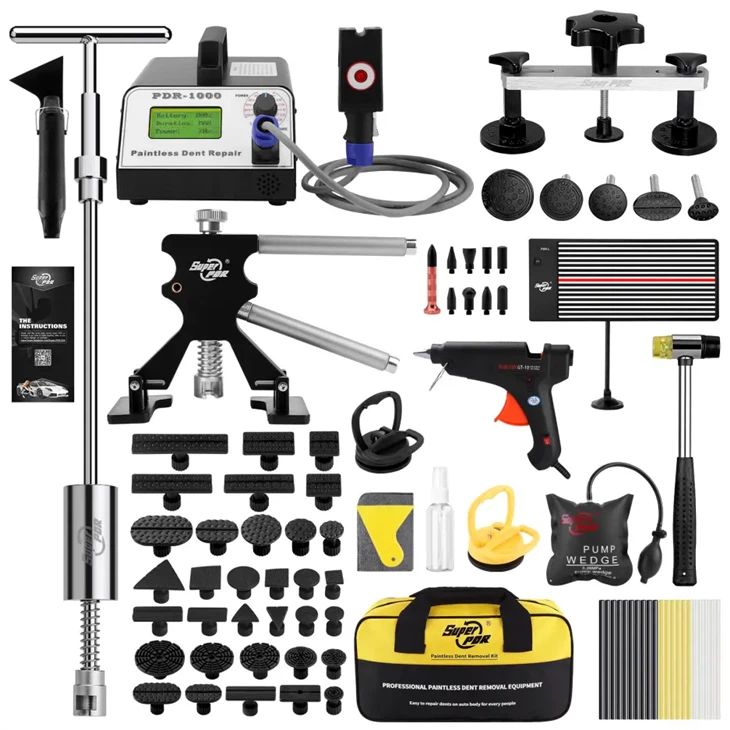
Super PDR product titles include hot box, induction heating, magnetic machine, PDR1000, rods, glue pulling kits, and line boards. Buyers should match these tools to the repair workflow: inspection, heat support if appropriate, metal movement, crown control, and final QA.
Risk control table
| Risk | Why it matters | Control method |
|---|---|---|
| Paint overheating | Can damage clear coat or repaint | Use conservative heat and inspect often |
| Hidden prior repair | Filler or weak repaint can react unpredictably | Ask history and inspect surface texture |
| Sensitive nearby parts | Trim, wiring, adhesives, and glass can be affected | Protect or avoid the area |
| Wrong dent type | Heat will not solve all stretched metal | Read dent with line board first |
| Overconfidence | Tool may be marketed as too easy | Require training and written limits |
Shop procedure before using heat
A shop should create a written procedure for heat-assisted dent repair. The procedure should include paint inspection, vehicle-area restrictions, tool setup, maximum caution zones, cooling time, and final QA. This protects the customer and the technician.
Suggested procedure:
- Document the dent and paint condition before repair.
- Confirm that no sensitive materials are immediately behind or around the work area.
- Set the line board and identify the low and crown.
- Use heat only as a support step, not as a blind first action.
- Inspect after each short application.
- Stop if the paint surface changes or the reflection worsens.
- Finish with normal PDR inspection and documentation.
Buyer education for hot box tools
For customer trust, product pages should explain both capability and limits. A useful hot box product page should answer:
- What type of dent is the tool intended to support?
- What training does the user need?
- Which areas should be avoided?
- What power supply is required?
- What accessories are included?
- What should be inspected before use?
Clear buyer education reduces returns and makes the page more likely to be used as a trusted technical source.
Comparing heat-assisted repair with conventional PDR
Heat-assisted repair is best understood as a support method. Conventional PDR still provides the main control. The technician reads the panel, moves the metal, reduces highs, and checks the finish. Heat may change how the panel responds, but it does not decide where the metal should go.
A useful comparison is:
| Method | Main control | Best suited for |
|---|---|---|
| Rod pushing | Tip pressure from behind | Precise lows with access |
| Glue pulling | External lift through tab | No-access areas and initial lift |
| Knockdown | Controlled downward correction | High spots and crowns |
| Heat support | Panel response and tension management | Selected broad or tension-based dents |
This comparison helps buyers understand why a complete repair setup still needs rods, glue pulling, lighting, and finishing tools.
Short FAQ
Can a hot box remove every dent?
No. A hot box can support selected dent repairs, but it does not replace rods, glue pulling, line reading, or finishing skill.
Can induction heat damage paint?
Yes, if used incorrectly or on vulnerable paint. Heat must be controlled and the paint must be inspected first.
Is heat useful for hail damage?
Sometimes, but hail repair usually depends more on mapping, rods, glue pulling, lighting, and finishing.
Should beginners start with a hot box?
Beginners should first learn dent reading, tool control, glue pulling, and safe finishing. Heat tools require additional care.